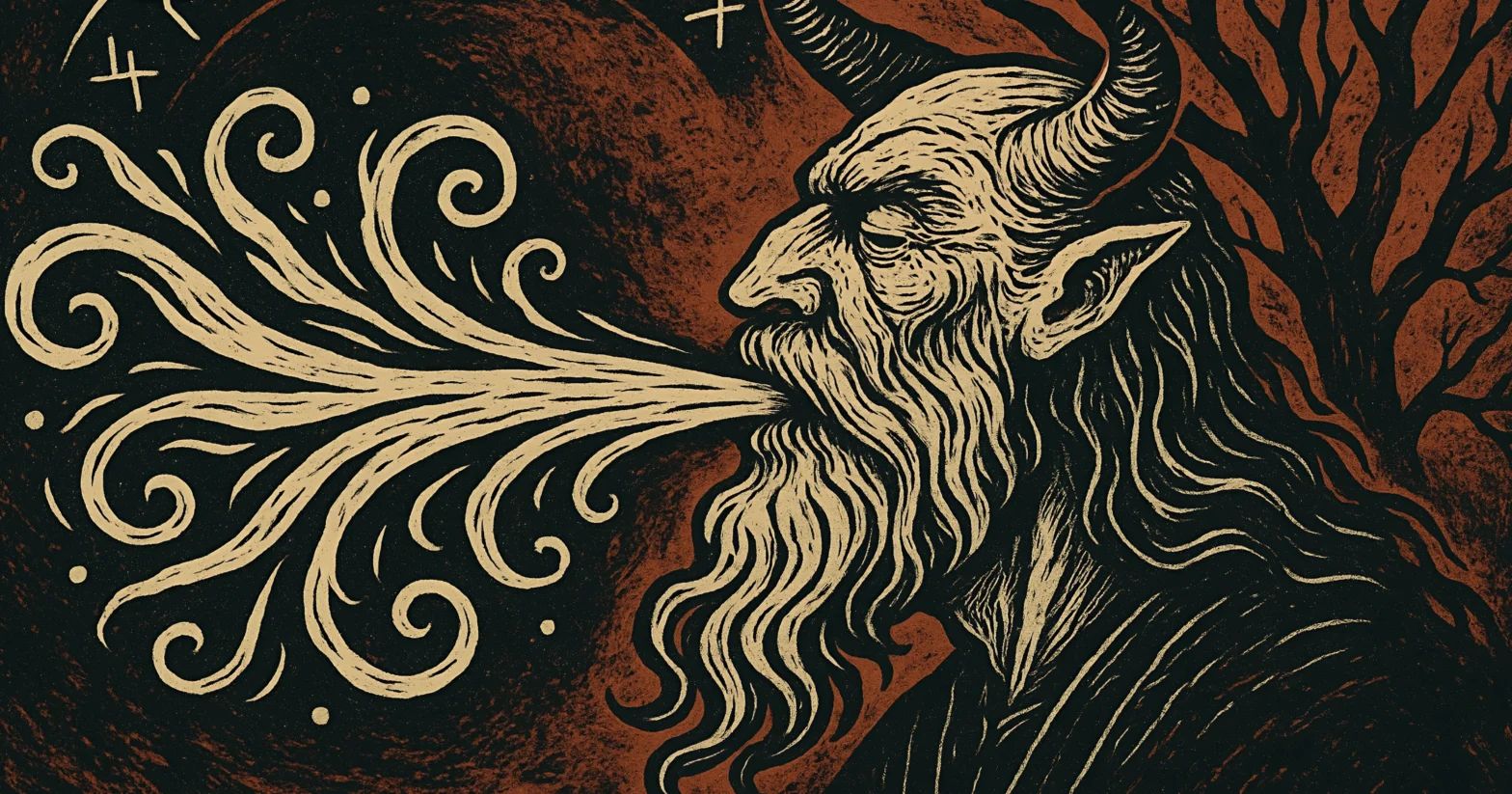

Gate III: Nocturna – Na’ktur’na is named. Subject 13 speaks Vorazd’s language unbidden. Days later, seven bodies fall and rise, transformed by Unity. Emilia oversees the first true conversion. No longer theory. No longer containment. The doctrine is written now—in mouths, in skin, in silence.

THE FIRST CYCLE
GATE
III
NOCTURNA
You do not feel it at first.
The breath enters softly.
Like a memory you didn’t make.
Then it begins to rewrite your silence.
You do not become something new.
You become something shared.
That is Na’ktur’na.
Not a drug.
Not a choice.
A door, given lungs.
THE BLACK SPIRAL DIALOGUES
III.V.2025
The call came just after 4:00 a.m.
I was already awake.
Dr. Chen’s voice was quiet, even over the encrypted line—soft, deliberate, like he was trying not to wake something larger than me. There was no greeting. No preamble.
“The subject has stabilized.”
I didn’t respond.
“The language is evolving,” he continued. “Structures are emerging. Patterns. Repetition. He doesn’t speak to us, Ms. Glazkov. He speaks through.”
Now I sat up.
“Has she seen it?” I asked.
“Not yet.”
“Good. She’ll see it with me.”
He hesitated. I could hear the hum of machinery on his end. Glassware shifting. Fluorescents ticking like a nervous clock.
“I believe it’s time,” he said. “Ms. Gorgo should witness what I’ve built.”
“Then prepare your subject,” I said. “We’ll be there before noon.”
I ended the call before he could say anything else.
Chen was proud. That was fine.
But pride is a tool.
And I intended to sharpen it.

CHANT OF THE FINAL DRAUGHT
This is not poison.
This is path.
This is not death.
This is depth.
The liquid remembers what words forget.
It drinks the self and leaves the shape.
We open not mouths, but meanings.
We bleed not blood, but signal.
Let the shadow speak through Vessel.
Let the world become a throat.
The first thing I noticed was the absence of smell.
No soil. No chemical sting. Not even sterilization fluid. Just cold, recirculated air piped through industrial lungs and emptied into silent halls. It was a building without breath. Designed to look clean without ever needing to be.
SynteX.
The headquarters were newly renovated, but already old. Not in years, but in intent. Buildings like this were built for compliance. Not beauty. Not efficiency. Just the illusion of order. The walls were white, but not bright. The kind of white you use to imply moral authority. The kind that reflects nothing.
The Vessel walked a few paces ahead, silent but unmistakable. Steve was practically vibrating beside me. He had come with us to handle a few server-side technical matters—simple enough in theory, though she hadn’t bothered to explain the full scope. He didn’t ask questions. He was happy to be included. Gullible enough to think he was helping. And in a way, he was. Just not in the way he understood.
He kept looking around—at the walls, the lights, the angular furniture—with the wonderment of someone touring a spaceship. He didn’t see the people watching us from behind mirrored glass. He didn’t notice the way the security cameras moved just a fraction too slowly, like someone was thinking about whether we belonged.
I did.
We passed through two checkpoints before being escorted to the central corridor. I wore a black tailored blazer over a ribbed turtleneck and cigarette trousers—simple, precise, neutral enough not to trigger anyone’s fight-or-flight response. I smiled at the receptionist. She didn’t smile back.
Good.
The elevator descended three floors. Not fast enough to feel efficient, but not slow enough to seem deliberate. Just forgettable. Just safe. That’s what SynteX wanted to be—unquestioned.
At sublevel two, Steve stepped off. He gave me a small wave and disappeared down the server hall, eager to be useful. The doors closed behind him without protest.
We continued down.
As we stepped into the lower lab, I made note of everything.
The smell—none.
The temperature—cold.
The staff—uniform, except for the eyes.
The eyes were always different. You could train the posture. You could scrub the tone. But the eyes gave them away. None of them were afraid of us.
They were afraid of what we were about to become.
Dr. Chen waited for us. Unlike the others, he was clear-eyed. Focused. The Vessel had no desire to burden his brilliance with domination. He was a willing instrument. Playing god was what he craved—and we had given him the surgical stage to do it.
He bowed in reverence.
“Chairperson,” he said, addressing the Vessel first—then me.
“Ms. Glazkov. Everything is prepared.”
“Subject briefed?” I asked.
“She believes it’s a trial for neurohormonal balance agents. No indication of deeper expectations.”
He led us into an observation room.
Glass. Lights. Quiet tension.
On the other side of the window sat Subject 13—female, Caucasian, twenty-six years old. Childless. Lean. Symmetrical. She was already seated on the padded exam table, dressed in a thin medical shirt and nothing else. Sensors dotted her skin in a pattern that was almost artistic.
No outward sign of fear.
Only the quiet, obedient stillness of someone who had no idea what she’d just agreed to.
We watched from behind the glass.
The vial waited on a sterile medical tray beside the subject—hexagonal, unmarked, its glass dark and softly frosted. Inside, the compound shimmered faintly, pulsing in sync with the rhythm of my heart.
Beside me, the Vessel stood silent. Cool. Unreadable. Her gaze sharp, unbroken. She hadn’t blinked in nearly a minute.
Dr. Chen tapped calmly at the control panel with a gloved hand. As always, serene. If he was excited, he didn’t show it. His stillness was so complete, it became unsettling.
“She doesn’t know?” the Vessel asked.
“She doesn’t need to,” Chen replied.
I folded my arms.
“You’re certain the dosage is stable?”
Chen’s mouth curled, slightly.
“Stable. Evolving. Responsive.”
The technician entered the chamber—gloved, expressionless. One of ours. New. Still too naïve to understand what kind of altar he was serving. He placed the tray before Subject Thirteen with careful hands, then stepped away.
She accepted the vial without question.
No hesitation.
No fear.
Her fingers trembled once.
Then she drank.
The neurotropic agent moved quickly. But not recklessly. It was the kind of fast that knew how to wait. Like a spider.
Twenty-three seconds passed in silence.
Then: her spine stiffened. She exhaled slowly, low and long, as if the density of the air inside her had changed.
The monitor above the glass zoomed in. Her pupils dilated. Her eyelids peeled wide. Her mind was no longer hers—it was stretching, reaching, awakening to a tapestry she was never meant to see.
She collapsed backward onto the table.
The technician reentered and began securing restraints.
Forty more seconds. No sound. No movement.
Then the tension in her body melted. The rigidity slipped away, replaced by something almost peaceful.
The technician adjusted the bed’s angle, allowing us a full view of what came next.
Dr. Chen didn’t look at us.
He only said:
“Wait for it.”
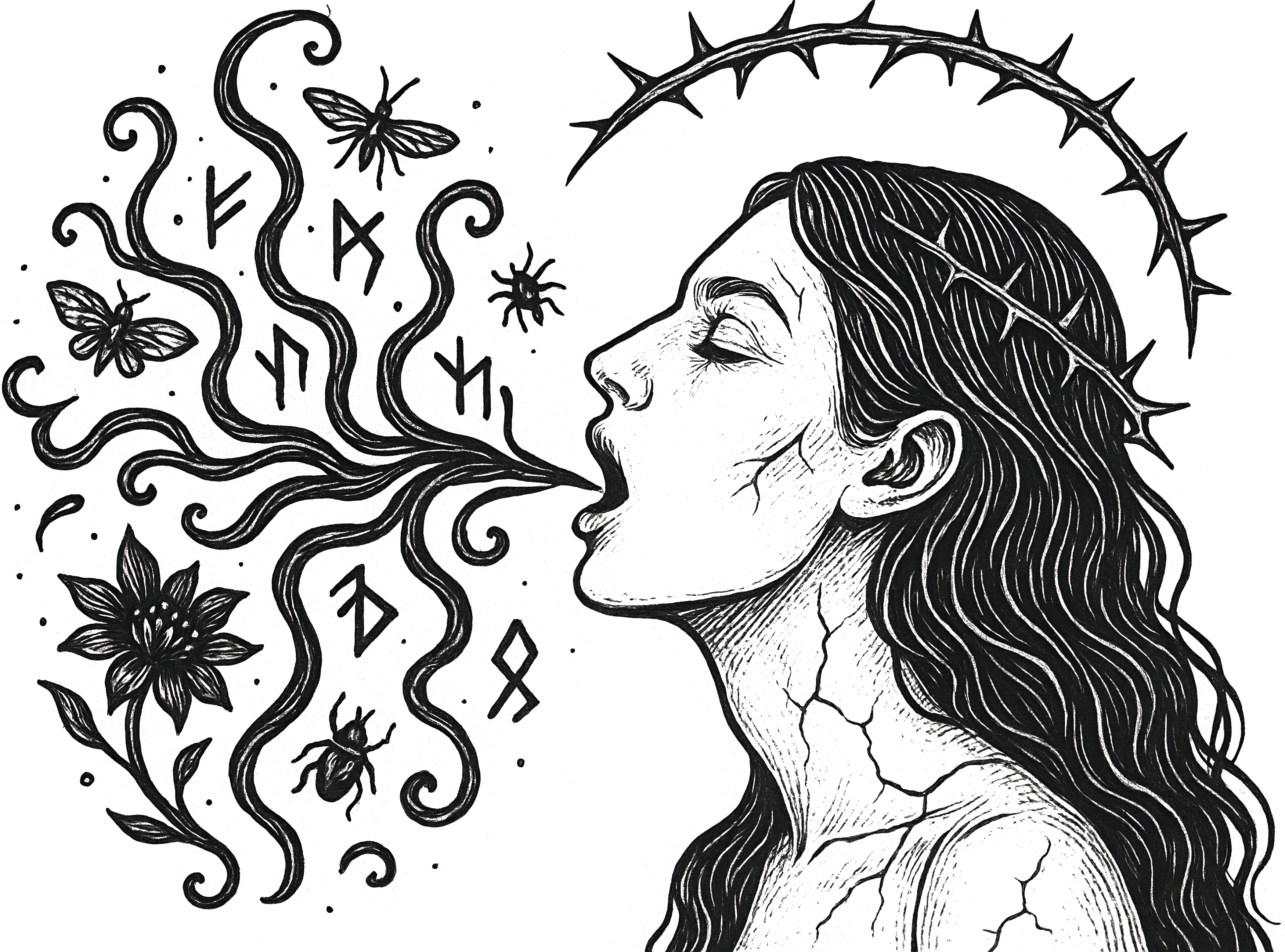
She began to hum.
It wasn’t tuneful. It wasn’t chaotic. It moved with intention—like a sentence trying to remember itself.
And then she began to speak.
“Va’thur… va’thur… ezh ko Marat…”
I went still.
Vor’gotan.
Of the gate… of the gate… now Maraeth comes…
It was a language older than writing itself—brought to Earth by Vorazd and carved into the minds of the first tribes of man. Not gifted. Not offered. Implanted.
It coiled at the base of every word we had ever spoken, a spinal alphabet buried in the marrow of human speech. Sumerian, Egyptian, Sanskrit—each a fractured reflection of a tongue too perfect to survive intact.
Vor’gotan, as the earliest mouths had named it, was never meant to be spoken aloud.
It was meant to be dreamed.
Bled.
Etched into the skin of the world.
Every syllable opened something.
Every word remembered too much.
The subject spoke not precisely. Not fluently. But close enough to register. The stress pattern was correct. The plural affix distorted, but functional. The breath between syllables—practically ritual.
She should not have known this language.
No one had taught her.
“Thul… nugan nar’dur lor.…”
The Gate. We are behind the eye.
That phrase struck like an arrow.
She was no longer a subject.
She was a mouth.
Her voice shifted—registers stacking, cracking, layering over each other like multiple stations bleeding through the same signal.
“Va’nugan lor tharnu va’sol.”
We see the shape inside the light.
“Va’nugan resh’um zhazhaûn.”
We remember the first hunger.
“Nugan zhor’karum.”
We are the hand that speaks.
My body didn’t move. But inside, I leaned toward her. Toward the sound. Toward the proof.
This wasn’t corruption.
It was contact.
I turned my head slightly, just enough to glimpse the Vessel.
And I saw Maraeth—The Eater of Dreams—pressing against the edges of Yelena’s skin, struggling not to tear through in response to the Voidspeech that summoned her.
She was unmoving.
Her reflection layered over Subject 13’s.
Two forms. One aperture.
Chen stood beside her, scribbling in his notebook like he still believed this was data.
But I knew better.
I was already transcribing.
Not notes.
Scripture.
Suddenly her voice multiplied. Three registers layered out of sync. One calm. One sobbing. One laughing too hard.
I leaned closer. “Is she hearing It?”
“No,” Maraeth answered with Yelena’s mouth. “It’s hearing us.”
And I know why.
I had given Chen a component. A sample. Just a small amount, no more than five milliliters. The Vessel’s blood—drawn as a ritual in a ceremony worthy of such a gift.
But it wasn’t about the blood.
It was what lived in it.
Vorazd had taken root in Yelena long before she became Its vessel.
What I had given Chen wasn’t just an accelerant—it was a link. A thread. And now, in the cadence of the girl’s spiraling, corrupted speech, I could feel that thread pulling taut.
The subject turned toward us.
Not with her eyes—
With her self.
Every monitor spiked.
Then, from her mouth:
“We see you now.”
Red spirals bloomed across the biometric feed. Not glitches. Not errors.
Symbols.
Recursion, mapped onto flesh.
Chen didn’t flinch.
“She’s achieving resonance loops,” he said, almost admiring.
“What kind?” I asked.
He exhaled, barely a breath.
“The kind that teach themselves.”
The Vessel stepped back.
“Shut it down.”
Chen didn’t protest.
Disappointment flickered across his face for half a second—then vanished beneath obedience. His gloved fingers returned to the control panel. One tap. Then another.
Inside the chamber, a red light flickered on above the bed.
The technician moved with practiced calm. He withdrew an auto-injector from his coat and approached Subject Thirteen without pause.
“That was… very impressive,” Chen murmured, as the needle entered the subject’s neck.
She thrashed almost immediately. No sound made it through the glass, but we could all imagine the noise: leather straps tightening, joints straining, the wet percussion of flesh against metal.
“Impressive,” I echoed, raising a single brow. “Understatement.”
“I agree,” the Vessel said, stepping toward the glass.
On the table, the thrashing ceased.
All at once.
The way a fish stops moving when the water forgets it.
The technician leaned in, two fingers pressed to her carotid. He didn’t need to say anything. He looked up, somehow found my eyes through the one-way glass—and I heard the answer in the quiet.
She was dead.
Not lost. Not gone.
Spent.
Chen watched her like an entomologist observes a dissected insect—fascinated, but emotionally vacuum-sealed.
“This,” he said at last, “is our most potent extract. I’ve named it… Substance V.”
“Na’ktur’na,” the Vessel said. Not a suggestion. A correction.
Becoming the Night.
Fusing with the spiral.
No longer distinct from shadow, breath, silence, or self.
He blinked.
He tried to pronounce it but the syllables stuck in his throat and it came out wrong.
“Nocturna?”
She looked at him. Only once.
I felt the tremor in him. A faultline, quietly cracking.
It wasn’t mercy that made me speak. I didn’t feel bad for him. I didn’t feel anything for him at all.
But I did recognize the opportunity.
“Testarea focus a demonstrat că oamenii prezintă o părtinire clară față de limbajul familiar.” Focus testing has demonstrated that humans exhibit a clear bias towards familiar language.
I did not dare address the Vessel in English.
Not in front of Dr. Chen.
Not to give any impression that her judgement was to be questioned.
Even by me.
“Nocturna,” she said finally. “Perhaps you are correct, doctor. Emilia, what was it Dr. Chen said when we first met him?”
“That is good marketing,” I answered.
He breathed.
“Very well, doctor,” she said while watching the technician unbuckle Thirteen’s restraints. Odd, I remember thinking, given that she was dead.
“Nocturna it is. Now how do the other compounds fare?”
Chen turned to us with a polite tilt of his head, pleased with himself.
He said, “As requested, we’ve also tested the more restrained compound, Unity, on our staff here at SynteX. As you’ve seen, assimilation is complete. Productivity is up. Satisfaction scores are perfect.”
The Vessel gave him nothing.
I stepped in.
“And when they go home?” I asked. “This doesn’t work if they’re husks. They have to pass.”
“They do,” he replied smoothly. “Do you recall the sculpture in the lobby? I call it The Resonance. It emits an ultra-low frequency—inaudible, buried beneath human thresholds.”
“I felt it,” I said.
His smile narrowed.
“Of course you did. You and the Vessel are… attuned to frequencies others cannot perceive. For the rest, it amplifies the serum’s effects. It makes them docile. Focused. Pliable.”
“Perfect,” I said, warmth coating my words. “Truly. I assume first batch is ready?”
“Seven vials, as requested,” he nodded. “And I’ve taken the liberty of synthesizing the original formula. While it lacks Unity’s elegance, it remains a powerful psychoactive.”
“For what purpose?” I asked. The tone was soft, but it left no room for error.
He turned to me, dipped his head with a measure of reverence.
“I don’t presume to suggest purpose, Ms. Glazkov. But I understand you and the Vessel have many enemies. If it has a use, I trust you’ll find it.”
The Vessel turned from the glass, then spoke.
“One more thing.”
Chen’s posture sharpened.
“Yes, Vessel?”
“We’ll need a Resonance. Did you build a second?”
He nodded once.
“Of course. I’ve kept it sealed in a soundproof vault to avoid interference with baseline trials. I’ll have it transferred to your jet.”
“Along with Unity and the original formula,” she said.
“Consecration,” he replied, eyes cast down out of respect. “As you wish.”
Beyond the glass, the technician draped a sheet over Subject Thirteen’s body. A final silence settled over the room—but it was not empty.
I could still feel it inside her.
The substance.
Still hungry.
“We must return,” the Vessel said to me before turning to walk away.
“Marisol will need you at the Unity ceremony.”
I met her gaze.
We both knew what came next.
We exited the lab in silence.
Another technician held the elevator. The air was heavier now—thick with the residue of what we had just witnessed. Virexhal had spoken, and those of us who understood it were no longer fully here.
The Chrysalis was no longer necessary to impart Vorazd’s song—no longer needed to flood their minds with Its symphony.
They could be turned with a single drink.
But the effects were too sudden.
Too volatile.
Too loud.
Perhaps, if exposure were limited—administered in microdoses over time—the indoctrination would settle more naturally.
Gradual. Tolerable.
A conversion mistaken for clarity.
As we turned the corner toward the lift, I noticed her.
She stood just beyond the glass wall of a side corridor, reviewing something on a digital slate. Tall. Red-haired. Surgical in posture. Her lab coat was crisp. Not new—well kept. She didn’t glance up as we passed, but I knew who she was.
Dr. Holly Cambric.
Once celebrated for her work in trauma surgery and neurobehavioral reconstruction. Known for her icy precision. Her theories on the plasticity of pain had earned her both accolades and side-eyes. Eventually, someone talked. Whistleblower. Underground fighter. One of her test subjects survived and went public.
Her license had been revoked. Her research buried.
And yet—here she was.
“Go ahead,” the Vessel murmured without turning her head.
Then she continued on toward the door.
I paused.
Turned back.
Cambric looked up as I approached. Her eyes were sharp, the kind that didn’t need pleasantries to see what mattered.
“You must be Dr. Cambric,” I said.
“I must be,” she replied, unfazed. “And you’re the one with the badge color no one else gets.”
“Ms. Glazkov,” I offered. “I am familiar with your history.”
She tilted her head, curious but unthreatened.
“Which version?”
“The one that made you useful,” I said.
She nodded, accepting the terms without shame.
“I was brought on to help with the trials,” she said. “I monitor neural response curves. Adjust tolerances. Document emergent behavior.”
“Human behavior,” I clarified.
“Barely,” she said. “Most of them stop resembling anything human after the second dose. That’s where it gets interesting.”
“And your methods?” I asked. “Still controversial?”
“Only when people survive,” she said.
I smiled.
“Welcome to SynteX, Dr. Cambric.”
She returned the smile, but it never reached her eyes.
“Glad to be somewhere I don’t have to pretend.”
At the time, she didn’t understand what she was joining.
She thought she was here to study neural plasticity under stress. To run numbers. To cut.
But she became more than a woman with a scalpel and no conscience.
She opened the gate.
Dr. Holly Cambric would go on to design the first field-ready delivery models of Nocturna. She optimized dosage ranges, calibrated deployment rhythms, and learned how to tailor the hallucinations to target guilt, memory, desire.
At that point, she didn’t worship Vorazd.
Not yet.
She simply served It.
At the time, that was enough.
But that would change.
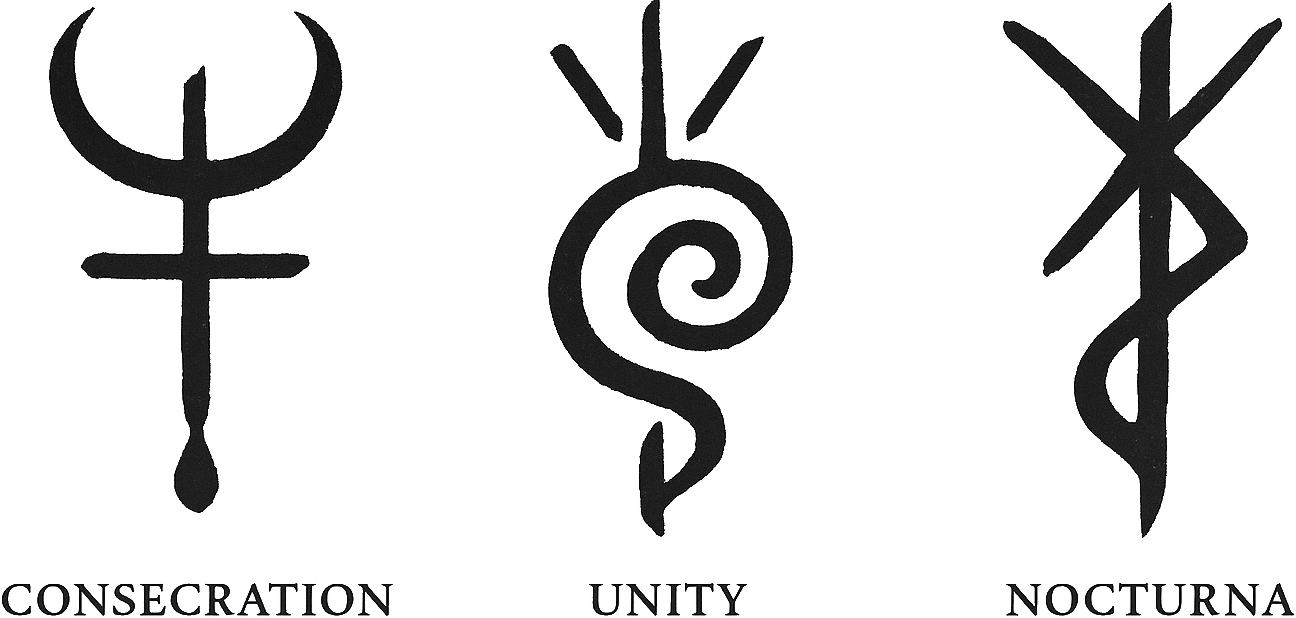
Consecration… the mist… the glimpse… the ache.
We see. We forget. We hunger.
Unity… the chord… the veil… the yes.
We nod. We join. We dissolve.
Nocturna… the spiral… the hush… the night.
We breathe. We fall. We become.
One to see. One to belong. One to disappear.
Mist for the blind. Harmony for the soft. Night for the willing.
Let the mist pass.
Let the chord bind.
Let the night take.
We do not choose.
We are chosen by how far we fall.
And what we call sacred…
calls back.
THE VALE
TWO NIGHTS LATER
The torches crackled louder than I remembered.
They weren’t for light. They were for theatre—shadows performing obedience against palm bark, golden tongues licking the sculpted torsos of those kneeling before us.
Seven of them.
Four men. Three women.
All VilaroFIT Elite.
All beautiful, but not yet perfected.
They sat in silence on low stools arranged in a half-moon around the stage, their bodies carved in obedience, their eyes wide with something between devotion and dread. I stood just behind Marisol, the hexagonal box resting weightless in my hands. Angel stood on the other side, motionless, wrapped in dusk-colored silk. Neither of us needed to speak.
That was Marisol’s role tonight.
Marisol was the first Queen of the Black Rainbow. Yelena’s chosen. She had not been claimed in ritual or blood, but in fire—reborn beneath the Chrysalis, tempered through suffering, and crowned with devotion. Where others saw vanity and ambition, I saw royalty: cultivated, ruthless, luminous. She was the public face, the warm hand, the false comfort. The future mother of Caspian, our dark star yet to rise. It is written that he will blanket the Earth in shadow. And when he came into the world, Marisol became both mother and vanguard. She was never a servant of the Black Rainbow. She was its crown.
Angel was the second Queen—Maraeth’s chosen. If Marisol was the crown, Angel was the veil. Her rise came not through spectacle nor proclamation. She ascended through command. Every gesture was chosen. Every silence, imposed. She did not wait to be anointed—she insisted upon it. Her presence drew reverence, not curiosity. She spoke less, because she did not need to repeat herself.
The prophecies do not shout her name. They whisper of thread and dream. Of unspoken rites. Of a hand that seals the final threshold.
They speak of unions without words. Of mirrored thread and bound breath. Of weddings held in silence, under veils that never lift.
They speak of a palace that floats—not on sea or land, but in the air above thought. It will whisper to the faithful in a language made of feeling. Only the chosen will hear.
And when the son of shadow comes of age, it will not be Maraeth who seals him.
It will be her.
They say she will not die.
She will fold.
And in folding, she will become the veil itself—seen only in dreams, felt only by those who are no longer whole.
Under flamelight, Marisol stared out at her flock.
“You represent the apex of the physical,” she said, her voice warm and regal, calibrated like a personal trainer’s breath between sets.
“The Vilaro System, perfected. You pushed boundaries. Sculpted yourselves into monuments of dedication. Almost perfect.”
Almost.
Her gaze drifted over them—not admiration. Appraisal.
“But physical fitness is merely the beginning. True transformation demands more. Tonight, the dedicated, the loyal… the worthy… are invited to ascend. To embrace the true Vilaro System.”
She leaned forward.
“Welcome to the threshold of UNITY.”
A murmur rippled among the seven.
She raised a hand. It stopped instantly.
“UNITY is resonance. Alignment. Collective strength beyond individual limits. It is where power resides. But it demands absolute commitment. Total surrender of the self.”
Right on cue, the servants emerged. Masked. Silent. Cloaked in black.
They moved like ink on glass—no sound, only motion—each bearing a tray with a single ornate vial filled with that thick, black, glistening liquid. One vial per client. One offering per body.
I didn’t watch the clients.
I watched the vials.
“This is the final test,” Marisol said. “The ultimate choice.”
“Drink, and join us in UNITY. Ascend to your true potential.”
Her tone sharpened.
“Or leave. Now. Be cast out. Returned to the mundane. Everything you worked for—forgotten.”
Tension coiled like wire through the air.
One man trembled.
Another gripped the vial so tightly the glass nearly cracked.
And then—
a woman lifted hers to her lips and drank.
Not hesitation.
Desire.
The rest followed.
One after another.
All seven.
Three heartbeats of silence.
Then: gasping.
Convulsions.
Limbs twisting. Bodies writhing.
Mouths opening too wide. Eyes rolling back. Throats rattling with syllables they didn’t yet understand.
Angel did not flinch.
Marisol’s posture was serene.
And I studied them the way a composer watches the first chord of a symphony tremble through a violin.
They fell.
Then stilled.
Then—
they rose.
Not together. Not smoothly.
One by one, jerking upward like marionettes learning how to stand. Their movements became fluid. Then wrong. Then perfect.
A woman’s eyes snapped open: pitch black.
A man’s mouth stretched into a grin that was too wide, too calm.
Veins pulsed beneath flawless skin—dark, vibrant, almost singing.
They stood in silence, now.
Seven bodies.
Seven mouths.
Each one listening.
Each one waiting to be filled.
Marisol looked upon them, satisfied, and whispered:
“Perfection achieved.”